
The low-code versus custom software debate is not really a technology choice—it is a match between business complexity and organizational capability. In 2026, more mid-size enterprises swing between "fast launch" and "long-term evolution"—low-code promises a prototype in two weeks; custom teams stress process depth and data sovereignty. The real question is never which side to pick, but: can your core differentiated processes be covered by generic components?

Industry Status: Low-Code Penetration Coexists with Custom Demand
Gartner's 2025 report puts global low-code market size above USD 32 billion, with roughly 18% CAGR. Meanwhile, over 60% of manufacturing and services IT projects in China still involve deep cross-system integration and industry rule customization. Low-code excels at forms, approvals, and light workflows; when business spans multi-entity settlement, batch traceability, or complex pricing engines, pure low-code often needs heavy "plugin" scripting later—raising maintenance cost instead of lowering it.
Three-Dimensional Complexity Model
XYN Technology summarizes three assessment dimensions from delivery practice: process variance (how much the same flow differs across orgs or categories), data coupling (real-time consistency requirements with ERP/MES/finance), and compliance audit depth (operation trails, permission granularity, graded protection requirements). If any dimension rates "high," prefer code-extensible custom or hybrid architecture.
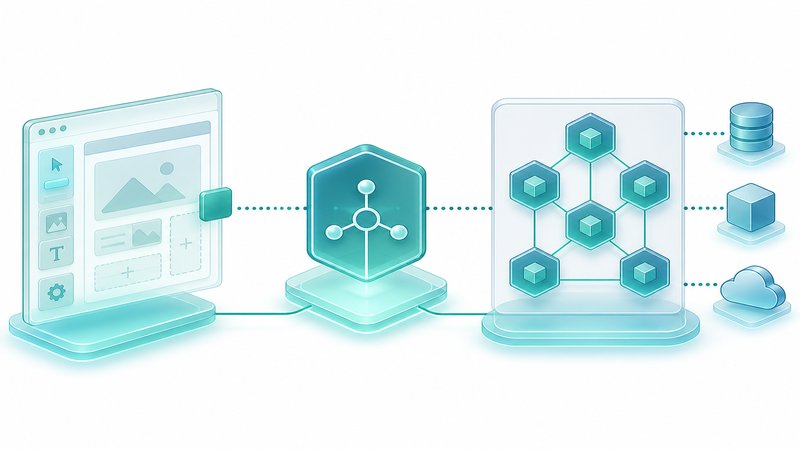
Core Technical Path: Hybrid Delivery in Practice
Separate Platform Layer and Extension Layer
Put UI, standard approvals, and report dashboards on low-code or rapid development frameworks; encapsulate pricing engines, inventory allocation, and reconciliation rules as independent services called via API. This keeps visual configuration efficiency while preserving testability and version control for core algorithms.
Contracts and Observability
Hybrid architecture success depends on clear interface contracts: each extension service defines input/output schema, error codes, idempotency strategy, and SLA. After launch, validate continuously via tracing and business metrics (document processing latency, exception retry rate)—avoid "fast front desk, blocked back office" hidden bottlenecks.
Practice Case: Food Group Order Middle Platform
The client's low-code system covered store replenishment and regional approval, but promotion stacking, batch priority, and credit limit checks changed dozens of times per year. XYN Technology kept the low-code front end and rewrote the rules engine and ERP sync module in Java microservices—average API response dropped from 2.3 seconds to 380 ms; promotion configuration cycle shortened from two weeks to two days. Acceptance criteria: rule changes need no release; full chain auditable.
For enterprises, the key is not chasing every tech buzzword but aligning goals, processes, data, and organizational accountability so every system investment maps to verifiable business results. Run bi-weekly metric reviews during implementation—cut low-value requirements early and concentrate resources on shortening cycles, reducing errors, and improving collaboration. After launch, treat operations as formal work: collect frontline feedback, watch exception tickets, iterate permissions and reports—avoid enthusiasm fading back to spreadsheets and IM groups.
Summary and Outlook
The rational 2026 choice is not "all low-code" or "all custom" but value-chain layering: platform for generic interaction, code for core differentiation. Complete three-dimensional assessment and three-year TCO at project kickoff; write extension boundaries, source ownership, and ops responsibility into contracts so tech investment stays comparable and reviewable against business outcomes.