In 2026, the competitive focus of enterprise custom software is no longer "who writes code faster" but who can build a verifiable engineering environment for agents. Industry practice shows that Anthropic trend reports and the OpenAI Harness Engineering path point to the same conclusion: productivity leaps come from systematic workflows, not one-off model upgrades. For mid-size software vendors and in-house R&D teams, this means shifting delivery from "humans write code" to "humans orchestrate agents that write code."
1. From Code Completion to Agent Autonomy
Over the past three years, AI-assisted programming mostly stayed at completion and snippet generation. Entering 2026, mainstream tools compete on task autonomy: understanding repo dependencies, cross-file refactors, running tests, and submitting reviewable changes. Analysis from Tencent Cloud Developer Community notes that multi-agent parallelism (write, review, test) has moved from demos to production pilots.
1.1 Three Coexisting Work Modes
- In-editor agents: daily feature iteration, emphasizing context indexing and multi-model switching.
- Terminal autonomous engineers: long refactors, scaffolding, and batch fixes.
- Platform orchestration: enterprises connect Issue, CI, and observability into one closed loop.
For custom projects, you need not pick one. Common practice: editor agents for daily speed, terminal agents for complex module refactors, and all critical changes flowing back to human review and release gates.
2. How MCP Reshapes Microservice Boundaries
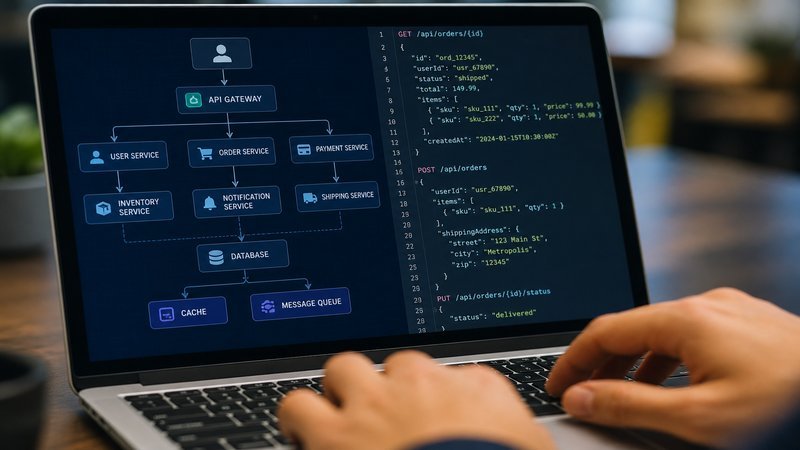
Model Context Protocol (MCP) has become one of the de facto standards for agent-to-tool communication in 2026. Its value is not "another RPC layer" but unifying databases, tickets, monitoring, and internal APIs into a discoverable, callable tool surface. For legacy microservice enterprises, the pragmatic path is: keep business services, add an MCP adapter layer, and let agents invoke capabilities in a standard way instead of rewriting entire systems.
2.1 Retrofit Priority
- Expose read-only capabilities first: log query, metrics query, config read—lower mis-operation risk.
- Then open low-risk writes: create branches, draft configs, submit preview environments.
- High-risk actions (delete, payment, production release) require mandatory human-in-the-loop approval.
Combined with cloud-native practice, Kubernetes and AI agent infrastructure are converging. Dynamic Resource Allocation (DRA) and first-class GPU/TPU support make "agents as a new microservice type" real. Enterprises can govern agent runtimes uniformly: quota, audit, secrets, and cost (FinOps) together.
3. A Deployable Engineering Loop
Harness Engineering experience shows: when agents underperform, it is often not weak models but missing AGENTS.md standards, test commands, and observability entry points. A replicable custom development loop looks like this.
| Stage | Key Output | Acceptance Criteria |
|---|---|---|
| Task definition | Issue breakdown and scope | Testable, rollback-safe, no hidden dependencies |
| Environment isolation | Separate worktree/sandbox | No pollution of main branch or local state |
| Execution loop | Generate → self-test → fix | Unit/integration pass or explicit failure reason |
| Peer review | Human or review agent | Security, performance, compliance checklist |
| Release gate | CI + canary strategy | Metrics stable, one-click rollback |
Across multiple custom projects, XYN Technology observes: when teams give agents "verification rights" (direct log and metric query), delegation rates rise sharply; when humans stay error messengers, efficiency breaks repeatedly.

4. Industry Cases and Cost Boundaries
In public cases, small teams using engineering harnesses produce large codebases in months—the core is not mysterious: focus human attention on environment and key decisions, delegate repetitive implementation to agents. But cost must be faced: token consumption, parallel agent count, and fix rounds all raise bills. Contracts should specify AI usage budget, retry limits, and human fallback ratios to avoid "looks fast, settlement out of control."
For manufacturing, foreign trade, and supply-chain clients, custom systems often coexist with ERP/MES/WMS. Agents should first connect master-data query and process orchestration APIs—not rewrite core transaction tables on day one. Clear security boundaries make delivery sustainable.
5. Implementation Advice and Outlook
If an enterprise plans agent-driven custom upgrades in H2 2026, a 90-day rhythm works: first 30 days for standards and read-only tool access; middle 30 days pilot one medium-complexity module; last 30 days consolidate templates, gates, and cost dashboards. Future competition centers on workflow integration depth—who can chain requirements, coding, testing, and release into an auditable pipeline delivers more verifiable value with the same headcount.
Custom software development is not disappearing; it is switching operating systems: humans own direction and accountability, agents own execution and iteration, engineering systems own constraints and proof.
6. Launch Checklist (Before Project Start)
Before starting an agent-driven custom project, align expectations with a checklist: is the repo indexable, can CI run in sandbox, is test data desensitized, is the MCP tool list reviewed, do production writes require human approval? One mid-size SaaS team, after introducing terminal agents, cut average bug-fix ticket turnaround from 4.2 to 1.6 days—but only after clearing flaky tests, otherwise agents spin on the same failing case burning tokens.
For buyers, contracts should clarify: IP ownership of agent-generated code, third-party model compliance, log retention period, and a whitelist of non-autonomous operations (drop database, price change, bulk refund, etc.). For delivery teams, put AGENTS.md, Makefile targets, and common diagnostic commands on one runbook page—new hires and agents share the same entry, reducing environment drift from oral handoff.
6.1 Typical Pitfalls and Avoidance
First pitfall: tool surface too broad—giving agents production DB read-only accounts for speed, then prompt injection or bad queries overload instances. Wrap queries via middleware API with row limits and timeouts. Second: missing observability—agents cannot verify after code changes, humans line-by-line watch. After log search and metric query access, delegation rates improve. Third: org rhythm mismatch—product ships weekly, agents iterate hourly, review becomes bottleneck. Template review checklists and two-tier gates: "auto-mergeable" vs "must human."