
A customer complained that a batch of products exceeded dimensional tolerances. The quality engineer’s first reaction is often: “Where are the inspection records?” If the answer is a stack of paper inspection reports, a few photographed forms, and the word “qualified” in a WeChat group, the traceability chain breaks at the very first step—making it impossible to determine which process, which machine, which batch, or which testing parameter went wrong.

Why can’t paper-based quality inspection keep up with modern manufacturing
Paper-based or semi-electronic quality inspection can still function in situations where there are few product varieties, fixed inspection items, and no traceability requirements. However, once you encounter scenarios such as: multiple varieties in small batches, customer demands for batch-level traceability, SPC statistical process control, isolation and disposition of nonconforming products, or coordinated incoming material and in-process inspections from suppliers, the shortcomings of paper records become apparent:
- Data cannot be aggregated: Metrics like pass rate, CPK, and top causes of defects cannot be automatically calculated; manual Excel summaries are slow and prone to errors.
- The closed-loop handling of nonconformities breaks down: After an item is judged nonconforming, isolation, review, rework, scrap, or concession acceptance proceed independently, with no state machine in the system.
- It becomes disconnected from production progress: Only after passing inspection can work be transferred to the next stage, but work reporting and inspection are not linked, so nonconforming items may still flow into downstream processes.
- Response to customer complaints is slow: Unable to quickly locate in-stock and in-transit items belonging to the same batch, equipment, or operator.
How should business processes be broken down: types of inspection and triggering points
Incoming material inspection (IQC)
Triggered upon supplier delivery and before materials enter inventory. Inspection items are based on material inspection specifications; if qualified, items move into available inventory; if unqualified, they are returned, isolated, or accepted under concession (subject to approval). Linked to purchase orders and supplier batches.
In-process inspection (IPQC)
Triggered during production according to process steps/frequency: first-piece inspection, routine inspections, and final-piece inspection. Linked to work orders, processes, equipment, and operators. Only qualified items are allowed to report completion or transfer to the next stage; unqualified items trigger the Hold mechanism—the current work order is frozen at that process step until resolution is complete.
Final product inspection (FQC/OQC)
Triggered before warehousing or shipment. Inspection specifications may be tied to specific customer order requirements. Qualified items are allowed to enter inventory or ship; unqualified items require rework or scrapping procedures.
Disposition of nonconforming products
State machine recommendation: pending review → under rework → reinspection → scrap / concession acceptance / return. Each disposition must record responsibility determination (internal/supplier/customer), quantity disposed, person responsible, and reinspection results. Concession acceptance requires approval and a defined validity period, to prevent “release first, paperwork later.”
How to design: inspection specifications, data collection, and traceability
Digitization of inspection specifications
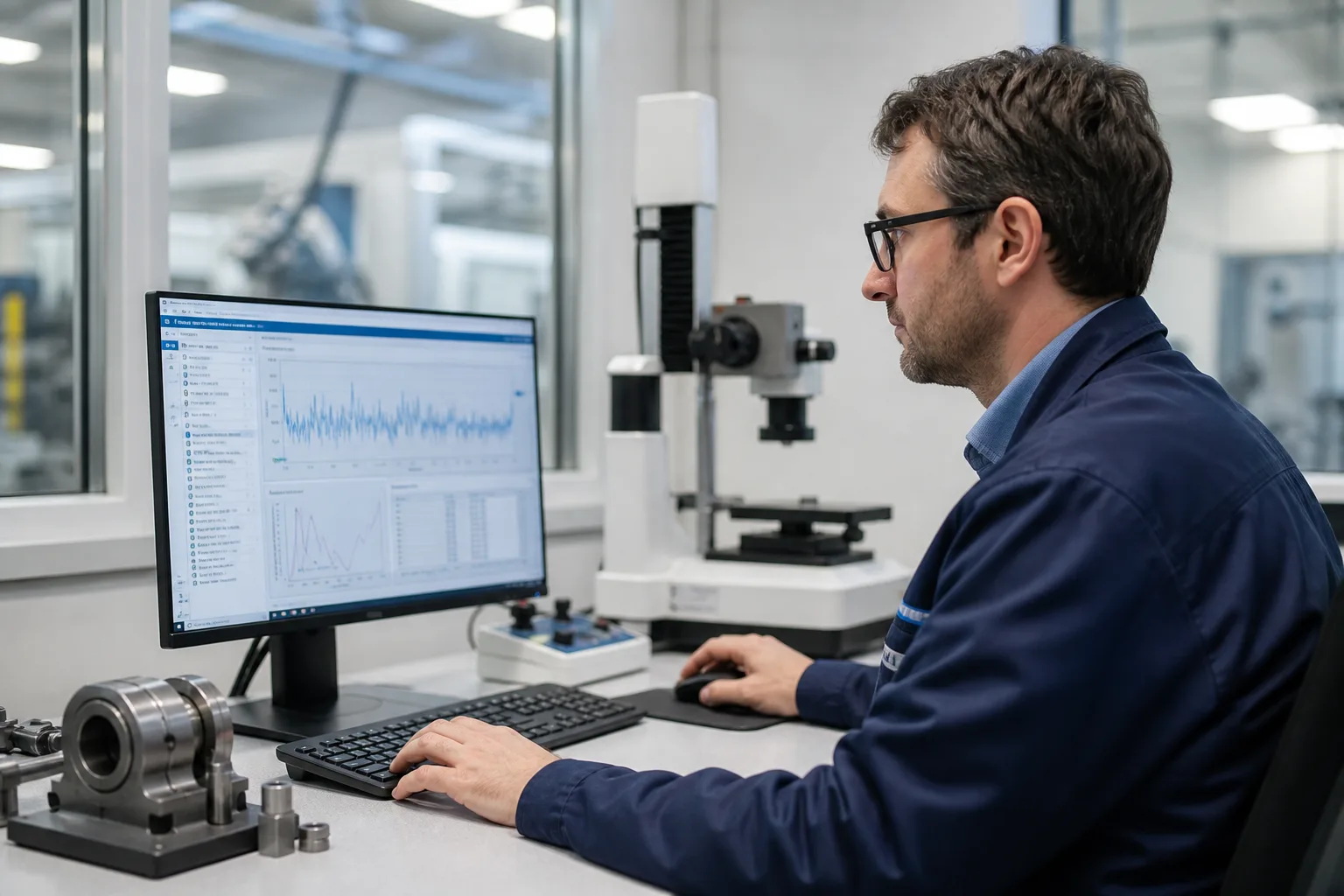
Each material/process should have structured inspection items: inspection item name, type (counting/measurement/appearance), standard values, upper/lower limits, sampling plan (AQL), and inspection method. Measurement items can automatically collect numerical data from testing equipment (calipers, CMMs, visual inspection systems), reducing human entry errors.
On-site data collection methods
Workstation terminals or tablets: Operators/inspectors scan the work order and process, and the system displays the list of inspection items, allowing manual entry or automatic data collection. Supports photo documentation(for appearance defects) and voice notes(for complex explanations). Mobile devices are suitable for routine inspections; fixed workstations are ideal for integration with testing equipment APIs.
Quality traceability chain
Forward direction: from raw material batch → production work order → process reporting → inspection records → finished product batch → sales shipment → customer. Reverse direction: from customer complaint SN/batch → tracing back to the same raw materials, equipment, and operator. The data model must maintain batch_genealogy(batch lineage) and inspection_record(inspection records) linkage.
How to develop and implement: equipment integration, SPC, and acceptance testing
Integration with MES/work reporting systems
Inspection serves as a pre‑entry gate for work reporting: if inspection is missing or fails, the work reporting interface rejects the submission. Rework orders must generate new inspection tasks to avoid “rework without re‑inspection.” Integrated with Andon: consecutive failures trigger line stops or call the team leader.
SPC and early warning
Measurement‑type inspection items can calculate X-bar and R control charts, with automatic alerts when limits are exceeded. Defect rates can be aggregated by process/equipment/team/material, supporting Pareto analysis to identify root causes. These capabilities rely on structured inspection data, which paper records simply cannot support.
Acceptance criteria
- Any finished product batch can have its full inspection record chain pulled out within 5 minutes(including incoming materials, in-process stages, and finished goods).
- From the moment a nonconforming item is identified to the completion of its disposition, the entire status can be trackedthroughout the process, with no “suspended” records.
- In customer complaint scenarios, it’s possible to quickly pinpointthe number of in‑stock/in‑transit/already shipped items from the same batchand generate a recall list.
- Key process inspection data is 100% linked to work reporting and process transfers100%, with no bypass routes.
Collaboration with supplier quality
Unqualified incoming materials often stem from external factors: if IQC data cannot be linked to supplier performance, purchase orders, and return procedures, the quality department can only repeatedly reject shipments without seeing any improvement curve from the supplier. The system should support: calculating supplier‑level pass rates, automatically triggering SRM corrective actions for major nonconformities, and requiring dual signatures from procurement and quality for concession acceptance. In this way, quality inspection ceases to be merely “blocking shipments” and instead becomes the gateway to a supply chain quality closed loop.
Common pitfalls
Only recording pass/fail results, without documenting actual measured values: making SPC and root cause analysis impossible.Disconnection between inspection and warehouse isolation: even after a nonconforming item is flagged, inventory status remains unfrozen, allowing it to be picked and shipped anyway.Delayed specification maintenance: when processes change but inspection items aren’t updated, the system effectively becomes meaningless.Lack of control over concession acceptance: on site, verbal releases are made to meet deadlines, leaving auditors unable to explain.
Moving from paper‑based to system‑based line inspection essentially transforms “pass/fail judgments” into computable, aggregatable, and traceable quality data assets, turning the closed loop of nonconformity handling and customer complaint response into built‑in process capabilities rather than post‑incident firefighting.
Shandong XYN Information Technology Co., Ltd. (XYN Tech) provides customized software development services for manufacturers related to quality inspection, production execution, and traceability, covering inspection specification modeling, on‑site data collection, equipment interfacing, and MES integration. For more details, see About Us and Customer Cases.