
In discrete manufacturing, when a planner asks, “Which operation is this order currently at?” the workshop supervisor checks the whiteboard, and the team leader scans the WeChat group—yet they still often fail to reach a consistent answer. Sales pushes for delivery dates, procurement urges for complete component sets, and finance calculates work-in-progress; each department ends up with a different version of “progress,” causing meetings to drag on longer and decisions to slow down further. The lack of visibility into process progress isn’t due to workers’ lack of effort—it’s becauseThe work-in-progress (WIP) status has not entered the data link that is queryable and reconcilable.。

Why can’t whiteboards and WeChat groups hold up?
Many factories operate as follows: the ERP system contains sales orders and production work orders, butProcess-level status is still updated manually.. Before leaving work, the team leader enters the completed quantities into the spreadsheet, and the planner can only aggregate the data the next day; when last-minute orders, rework, or outsourced returns are added, the numbers on the whiteboard fall behind the actual situation on the shop floor. Photos and voice messages in the WeChat group cannot be structured, nor can they be linked to work order numbers, process numbers, or equipment numbers.
When a product’s process route exceeds five operations and there are more than three parallel workstations, the vague statement “about 80% complete” can distort both the bill-of-materials check and the shipping schedule. According to a survey on manufacturing digitalization,In cases of delivery delays, about 40% are attributable to lagging on-site progress information., rather than an absolute lack of production capacity. With progress invisible, bottlenecks are concealed: one process step becomes congested while the downstream remains idle, yet management continues to allocate production evenly.
How to break down the business: work orders, processes, and work-in-progress—three key aspects.
To manage progress effectively, we must first standardize our terminology. It is recommended to break down the on-site status into three layers of objects:
- Production work order: Corresponds to the MO in ERP/MES, carrying quantity, delivery date, and BOM references;
- Process task: The executable unit after the work order is expanded according to the process route, bound to a work center or equipment;
- Work-in-progress batch: The quantities of the same work order that are pending processing, in process, pending inspection, and completed at a specific operation.
The business rules must clearly specify:What actions count as “start of work” and what actions count as “completion”?For example, in machining, work starts when the program is initiated or the first piece passes inspection, and it ends when the last piece passes inspection and the quantity is reported. On the assembly line, work begins when a pallet enters the workstation, and it concludes when the workstation releases the item after scanning. If these rules are inconsistent, the WIP in the system will not match the physical inventory.
Role and Permission Boundaries
Typical roles include: Planner (creates/adjusts work orders, views plant-wide WIP), Team Leader (reports work and exceptions for their team), Quality Inspector (intercepts non-conforming items, triggers rework procedures), and Warehouse Manager (handles inter-process transfers and triggers inbound storage). Permissions should…By Organization + Work CenterSegmentation prevents frontline staff from seeing irrelevant order costs and ensures that planners can view the accumulation of bottleneck operations.
How to design: state machine, data collection points, and reconciliation
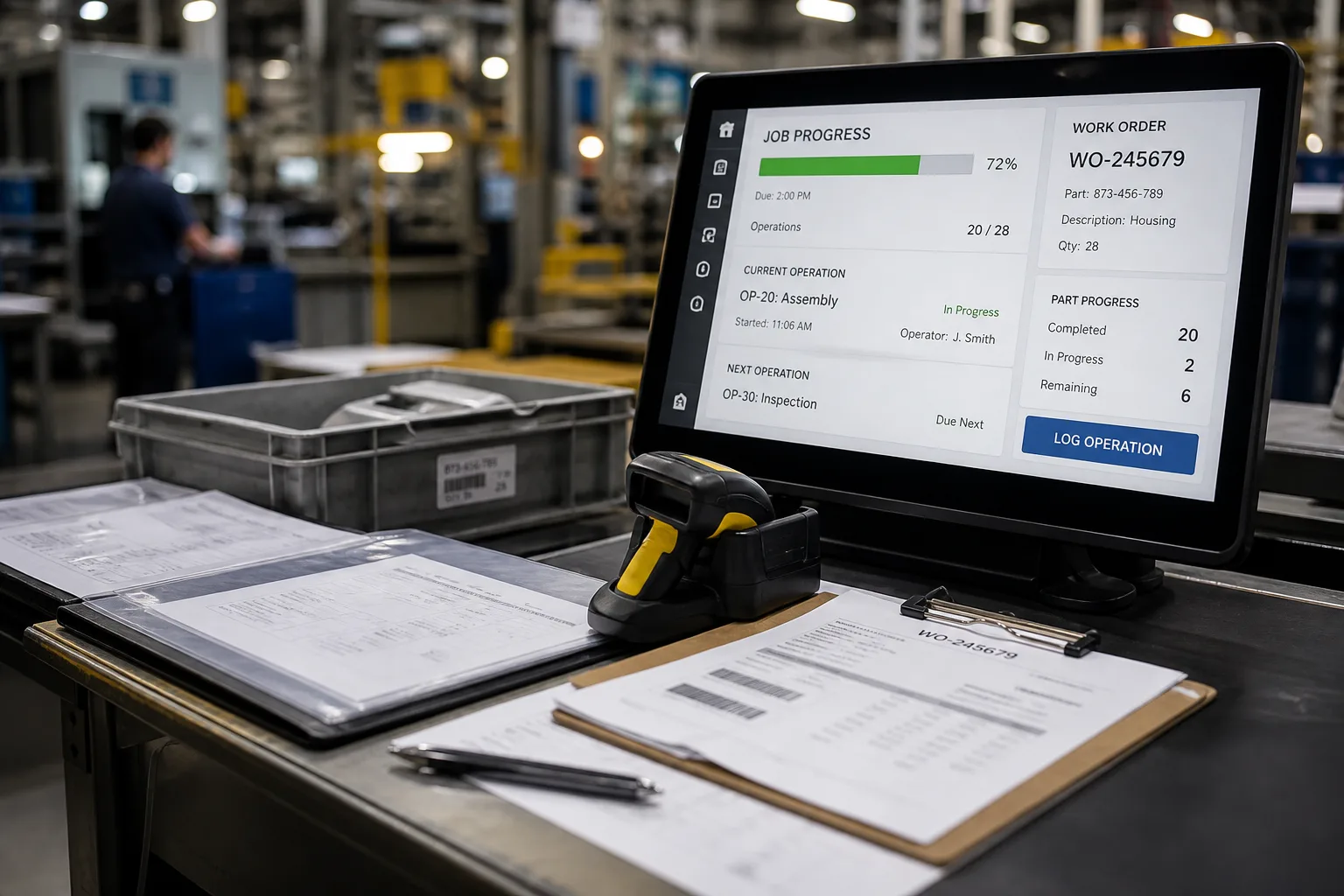
The core of the process progress system isProcess state machine: To be scheduled → Assigned → In processing → Pending inspection → Completed / Reworking / Paused. Each status transition must record the operator, timestamp, quantity, and optionally the equipment/station ID. During design, reserve fields for “Pause Reason Code” and “Rework Target Process”; otherwise, exception orders will bypass the system and proceed offline.
How do you choose the collection method?
Collection doesn’t have to be fully automated in one step; it can be staged according to maturity levels:
- Workstation terminal reports work.: Tablet or industrial touch screen; after scanning the work order/process barcode, enter the completed quantity; low cost and quick to deploy;
- Device data integration: CNC, SMT, etc. report operation and counting data via OPC/MTConnect/vendor APIs; suitable for bottleneck equipment;
- Andon is linked with XYN Tech.: One-click reporting of pauses, material shortages, and quality anomalies; automatic freezing of process statuses.
- RFID/Pallet Tracking: In batch circulation scenarios, multiple work order in-process locations are associated via the pallet ID.
The design principle isMaking accurate reporting easier than concealment.: By default, work orders and standard man-hours are automatically populated, allowing workers to complete time reporting in a single step; for exceptions, the reason must be selected, rather than permitting a prolonged “in progress” status without closing the record.
How to align with ERP work orders
The division of responsibilities between the MES/schedule system and ERP must be documented in the interface contract: ERP issues work order master data and BOMs; the shop-floor system sends backCompletion quantity, man-hours, and scrap; ERP accordingly deducts materials and updates order completion rates. It is crucial to avoid allowing both systems to “modify quantities” without auditing. A common practice is to designate ERP as the source of truth for finance and orders, while the shop-floor system serves as the source of truth for process status,With event synchronization + daily reconciliationDigest the differences.
How to develop and accept?
The interface layer is recommended to be event-driven: one message should be sent for each of the following events—work order issuance, work reporting, quality inspection determination, and process transfer—to facilitate subsequent integration with dashboards and large screens. The front end provides this to the team leader.View this group’s to-dos and exceptions on a single screen., to the plannerWIP heat map by order/process/delivery date. In terms of performance, a single plant should be able to process thousands of concurrent work reports with near-instant visibility; otherwise, the shop floor will revert to paper-based reporting.
Acceptance testing should not only verify “work reporting capability.” Instead, 10 real work orders should be randomly selected for testing.End-to-end tracking drill: Process each item—rush orders, rework, outsourced material returns, and equipment‑related production halts—and verify that the ERP completion status matches the physical inventory on site. During the first two weeks after go-live, perform daily WIP reconciliations; any discrepancies exceeding the threshold will be automatically escalated to Planning and IT.
The most common pitfalls when implementing it
First,Process route maintenance is not timely., the new product still uses the old template for work reporting, and the data has been incorrect since day one. Secondly,Turn the progress system into an assessment tool., team leaders concealed or retroactively reported information, and after trust collapsed, the system was rendered ineffective. Thirdly,Only complete orders are collected; exceptions are not., Pauses and material shortages are not reflected in the system, so bottlenecks always “appear normal.” The solution is to integrate the system into pre-shift meetings and the exception escalation process, rather than adding extra paperwork.
When process progress is well managed, delivery-date commitments have a solid basis, and work-in-process capital tie-up can be accurately calculated. For discrete manufacturing enterprises, this is often more urgent than purchasing another “large ERP module”—because the problem lies inThe on-site status is not digitized., rather than missing a new report.
Shandong XYN Information Technology Co., Ltd. (XYN Tech) has long been providing customized systems for manufacturing, foreign trade, and the physical industry, covering production scheduling, warehousing, and CRM. Welcome to visit.About UsUnderstand the boundaries of engineering practice and delivery.